The Altitude Test: Are You Leading at the Right Level?

In my 20+ years as an executive coach, I realized that most leaders do not struggle because they lack discipline, intelligence, or work ethic. In fact, that is almost never the problem. They are usually working very hard—answering emails, preparing for meetings, helping their teams, solving problems, responding to requests, and trying to keep everyone moving in roughly the same direction.
The problem is not that they are not doing enough. The problem is that they may be spending too much time at the wrong level.
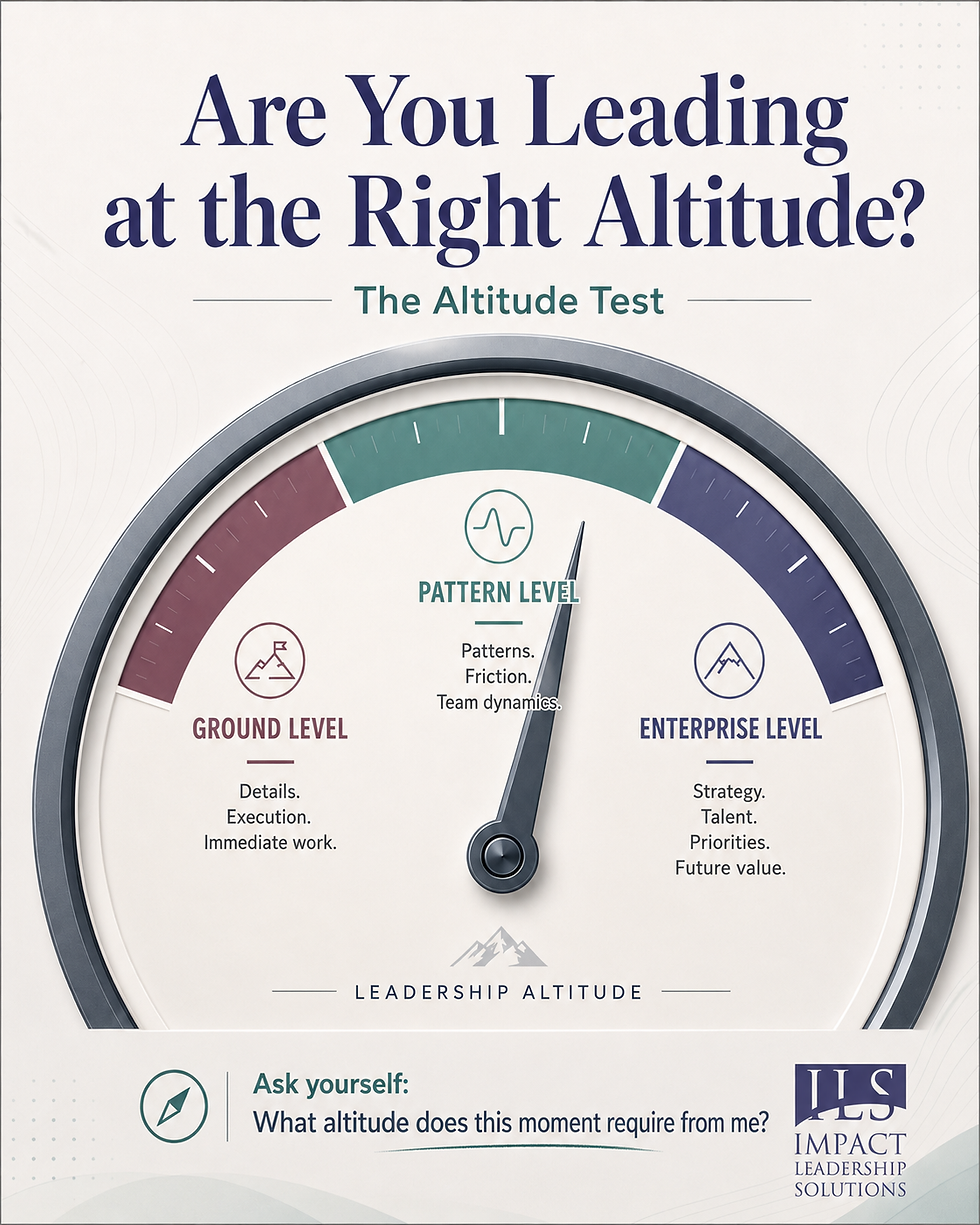
One of the concepts I’m writing about in my new book is what I call The Altitude Test. The idea is simple: different leadership moments require different levels of attention. Some issues require you to be close to the work. Some require you to step back and look for patterns. Some require you to rise higher and think about strategy, culture, talent, priorities, and the future.
The question is: What altitude does this situation require from me?
That may sound simple, but it is not always easy. Many leaders default to the altitude where they feel most useful. For high achievers, that is often ground level. They jump in, solve the problem, answer the question, review the document, fix the mistake, and keep things moving. This is useful leadership—until it becomes the only kind of leadership they practice.
And that is where things get tricky.
The Trap of Being Useful
Many successful leaders were promoted because they were excellent at execution. They knew the details, followed through, solved problems, and became the reliable person others could count on. That is a wonderful way to build credibility, and it is also a very sneaky way to build a job you can never escape.
Many leaders default to the altitude where they feel most useful.
At some point, the same behaviors that made you successful can start to work against you. People bring you every decision because you are good at deciding. They bring you every problem because you are good at solving. They invite you to every meeting because you contribute well. Before long, your calendar looks less like a leadership tool and more like evidence in a workplace crime documentary.
This is how talented leaders become bottlenecks, even with the best intentions. They are not trying to micromanage. They are not trying to disempower people. They are usually trying to help. But help becomes expensive when it keeps everyone else from building judgment, ownership, and confidence. The real issue is not whether you are willing to help. The issue is whether your help is creating leverage or dependency.
The Three Altitudes of Leadership
At the Ground Level, you are focused on the immediate work in front of you: the email, the document, the client issue, the team question, the decision that needs to be made before the end of the day. Ground-level work matters. Leaders should not float above the business pretending details are beneath them. That is not "strategy"; that is avoidance in nicer shoes.
The problem is when leaders live at ground level all the time. If you are constantly pulled into every detail, you may feel productive, but you may not be doing the work only you can do. You are moving things forward, but you may also be training everyone around you to wait for you.
At the Pattern Level, you step back and ask what keeps happening. Why does this decision keep coming back to me? Where are people unclear? What is creating friction? What conversation are we avoiding? What process is making this harder than it needs to be?
This is often where the real leadership work begins. A missed deadline is a problem. Repeated missed deadlines are information. One tense meeting may be a bad day. A pattern of tense meetings may reveal unclear roles, low trust, or a team that has mastered the fine art of being polite while silently disagreeing with everything being said.
At the Enterprise Level, you rise higher and think about what matters most. This is where you look at strategy, culture, talent, risk, priorities, and long-term value. You ask: Where does my attention create the most leverage? What should I stop owning? What needs to change before it becomes more expensive? What kind of leader does this moment require me to be?
This is the work many leaders say they want more time for. The hard truth is that time for higher-level leadership rarely appears on its own. You usually have to reclaim it from lower-level work that keeps sneaking onto your calendar disguised as something “quick.”
And as we all know, “quick question” is one of the great lies of organizational life.
Why This Matters
As leaders move up, their value changes. Earlier in a career, value often comes from how much you can do. Later, value comes from what you can see, simplify, anticipate, shape, and develop in others.
That does not mean you stop caring about execution. It means you stop confusing your involvement with your value. Those are not the same thing.
One of the most important leadership shifts is moving from “How can I help solve this?” to “What does this situation need from me that only I can provide?” Sometimes the answer is a decision. Sometimes it is coaching. Sometimes it is clarity. Sometimes it is a boundary. And sometimes it is the very difficult leadership discipline of not responding immediately just because you can.
For many capable leaders, restraint is harder than action. Action feels useful. Restraint can feel uncomfortable. But if every issue gets your immediate involvement, you may unintentionally teach your team that their judgment is optional and your availability is unlimited.
Action feels useful. Restraint can feel uncomfortable.
Coach’s Tip: Try the Altitude Test This Week
Look at your calendar from last week and ask yourself three questions.
Where was I too close to the work? Look for meetings, decisions, or tasks that did not truly require your involvement.
What pattern did I notice but not address? Look for recurring confusion, repeated friction, delayed decisions, or problems that keep landing back on your plate.
What needs a higher-altitude response from me this week? This might be a clearer priority, a more direct conversation, a better delegation, a boundary, or a decision you have been postponing because you were hoping it would somehow resolve itself through the magic of time and mild avoidance.
Your calendar is one of the most honest leadership documents you own. It shows what you value, what you protect, what you tolerate, and what quietly takes over when you are not paying attention.
The Bottom Line
Leadership is not about staying high above the work all the time. That would make you disconnected and possibly irritating. The goal is to move between altitudes with intention.
Sometimes your team needs you to be close to the work. Sometimes they need you to see the pattern. Sometimes they need you to rise higher and create clarity about what matters most.
The best leaders can zoom in without getting stuck, and zoom out without losing touch. They understand the details without drowning in them. They notice patterns before they become chronic. They protect time for the work that shapes the future, not just the work that makes the most noise today.
So the next time you find yourself pulled into another decision, another meeting, or another “quick question,” pause and ask: What altitude does this moment require from me?
That question will not magically clear your calendar. Sadly, I do not have that power. But it may help you lead your week with more intention—and help others experience you as a leader who brings not just effort, but perspective.
👉🏽Do you want more real-life leadership tips? Sign up for the Monday Morning Mentoring YouTube channel and the ILS bi-weekly newsletter. Also, follow me on LinkedIn.


